From the patient field guide
Semaglutide in STEP: what treatment adjustments can tell us
A scientific reading companion on recorded actions, outcomes and the comparisons needed to connect them.
Clinician medical review has not been completed.
An action is a record, not yet a result
STEP-1–3 studied adults with overweight or obesity for 68 weeks; STEP-2 included type 2 diabetes, while STEP-3 added intensive behavioral therapy.[1]
A record that an action occurred answers a question about what was done. Establishing whether it helped requires another kind of answer: what outcome would have followed a specified alternative. The distinction becomes easy to lose when an action sounds purposeful. A response may have a sensible aim, yet its aim is not a measurement of its effect. Reading a management record therefore begins by separating the decision, the result that followed, and the comparison needed to connect them.
That separation gives descriptive information a useful role. Counts can identify which actions deserve a closer research question. They can also make a reporting category concrete enough to examine. But counting how often a response was recorded cannot establish how much benefit it produced. The relevant evidence would have to concern an outcome, not merely the presence of an action label. A larger collection of action labels would make the descriptive record more extensive without, by itself, creating the missing comparison.
A practical way to read is to ask what would need to change in the evidence for the conclusion to change. Would a clearer definition settle an ambiguity about what happened? Would a timeline settle whether a proposed consequence came afterward? Would a comparable alternative be needed to estimate an effect? These are different information requests. Keeping them separate prevents an accurate observation from being dismissed as useless, while also preventing it from acquiring an answer it was never designed to provide.
Read the action counts
Safety N=2116; on-treatment meant a dose within the previous 49 days.[2]
A person count and an action count can look alike on a graph while representing different units. A count of people meeting a condition tells us how many records contain that condition. It does not tell us how many times it occurred for each person. To investigate repetition, the record would need to retain separate occurrences. To investigate how many distinct people appear across categories, it would instead need to preserve shared membership. The intended question determines which detail must survive the summary.
Adding category totals is justified as a count of unique people only when membership is mutually exclusive, or when overlap has been accounted for. Otherwise, addition counts memberships. A person represented in more than one category contributes more than once to that sum. This is a property of the counting rule, not evidence of an error in either category. The necessary next step is to identify the joint membership information, rather than assume that separate bars describe separate sets of people.
Joint membership would still leave a different question unresolved: order. Appearing in both categories does not say which action came first, how far apart they were, or whether the labels refer to the same episode. Those questions need linked records with timing. Nor does a category's size establish that its action was preferable; frequency and effectiveness have different definitions. A careful reading can therefore preserve the count exactly while declining to turn its size into an account of sequence, recurrence, or success. The visual arrangement should make that restraint easy rather than encourage a pie-like reading of separate categories.
Reading the records
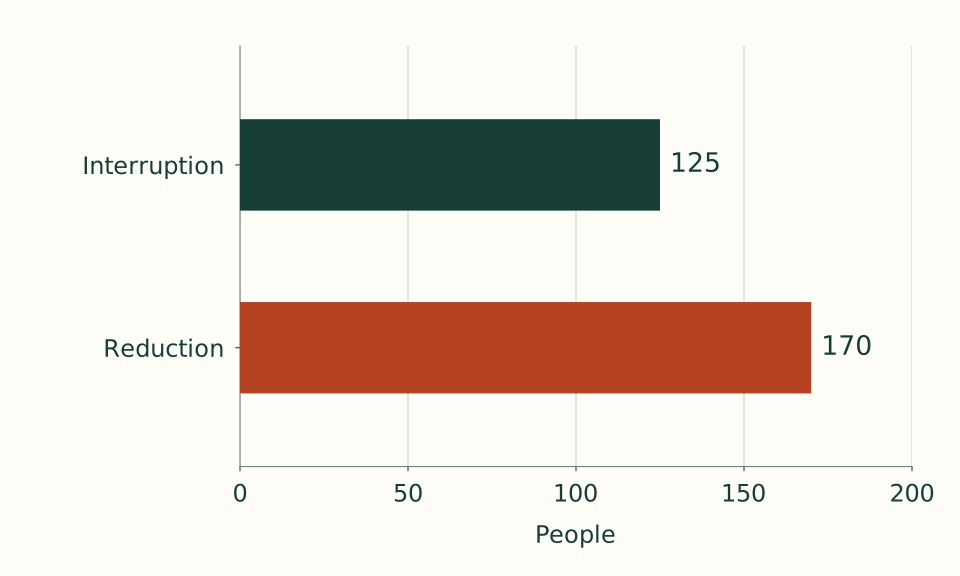
Open the chart’s data table
| Action | People |
|---|---|
| Interruption | 125 |
| Reduction | 170 |
Who received the action?
Management actions were not randomized comparisons.[2]
Consider the logic of a decision made in response to a problem. If the problem's intensity influences which response is chosen, and also influences what happens later, the response groups already differ in a way relevant to the outcome. A later difference could then reflect the starting problem, the response, or both. Without information that separates those contributions, an observed association has more than one explanation. This is a conditional reasoning problem; it does not require assuming that any particular imbalance actually occurred.
Random assignment at an earlier stage cannot automatically solve every comparison constructed afterward. The protection belongs to the allocation it created. If a later action depends on subsequent experience, grouping people by that action introduces a new selection rule. It would be necessary to evaluate that rule in its own right. Treating every later grouping as if it inherited the earlier randomization would erase the very decision process the management question seeks to understand. The unit of scrutiny is the particular comparison, not the study's broad label.
Recording reasons for a decision could make this problem more inspectable, but a recorded reason is not an automatic correction. One must ask whether it was measured before the action, whether it captures the relevant differences, and whether comparable alternatives remain among people with similar recorded circumstances. Adjusting for a consequence of the action would answer a different question from accounting for a preceding reason. An analysis should explain that ordering before presenting an adjusted result. These requirements identify what a convincing comparison would need; they do not establish the direction or size of any distortion in a particular dataset.
Put the records in order
A useful timeline would distinguish when a problem began, when a management decision was made, when the action took effect, and when the outcome was assessed. These are separate dates even if a reporting system happens to collect some of them together. Their order determines which explanations are possible. An outcome already reached before an action cannot be attributed to that later action. An outcome measured afterward permits the proposed explanation, but does not select it over every alternative explanation.
The assessment schedule also belongs on the timeline. If one group is checked sooner than another, an apparent difference in recovery time could partly reflect when recovery was sought or recorded. An unobserved interval should not be silently converted into an exact event date. A reporting plan could distinguish known dates, intervals within which something happened, and periods without an assessment. That would allow the reader to see whether the timing supports a precise claim or only a broader ordering. No claim about a particular study's reporting omissions is needed to specify this requirement.
Repeated decisions make the timeline more demanding. The circumstances leading to a later response may themselves have been affected by an earlier response. A single label attached at the end could compress that sequence into an apparently simple exposure. To study the sequence, each decision would need its own preceding information and subsequent follow-up. It would also help to distinguish a newly chosen response from continuation of an earlier one. The scientific task is to preserve the order relevant to the question, rather than infer a sequence from the fact that several labels eventually appear together.
Define the alternative
An effect question needs an explicit alternative. “What happened after an action?” can be answered from a sequence of observations. “What did the action change?” asks how outcomes would compare under another specified course. Unless that course is defined, the comparison can shift while the language of benefit stays the same. A research proposal should identify the decision being studied, the circumstances under which people could enter that comparison, and the alternative whose outcome would be used to judge the first course.
The starting point must match that decision. Classifying people by whether they ever received an action uses information accumulated after follow-up begins. Someone who has not yet received it may later move into the action category. Comparing those final labels from an earlier starting point can therefore mix time before a decision with time after it. The time available to acquire a label may become part of the apparent comparison. Beginning at a shared, clearly defined decision point helps reveal what information was actually available when the alternatives were considered.
Follow-up should then address the same outcome over a comparable horizon. A longer opportunity to observe a result should not be mistaken for a better strategy. A proposal would also need to specify how later changes in course relate to the question being asked, rather than decide that after inspecting favorable outcomes. These are instructions for defining research, not for choosing a patient's treatment. They make it possible to distinguish a comparison of initial decisions from a comparison of sustained courses, and to see when a conclusion has moved from one question to the other.
Decide what helped means
ICH distinguishes the treatment effect of interest from the method used to estimate it.[3]
The word helped can conceal several goals. Relief of a problem, the ability to continue a course, and less disruption of daily activity are different possible outcomes. A favorable result on one would not logically guarantee a favorable result on another. Before comparing alternatives, a research question must therefore say which change it values. Otherwise, the same collection of observations could be used to tell different success stories simply by switching the goal after seeing which result looks most encouraging.
The time horizon is part of that definition. An outcome assessed soon after a decision and an outcome assessed much later can answer different questions even if they use the same scale. Combining several outcomes introduces another choice: how much influence each receives. A composite can be useful, but its meaning depends on those ingredients and on the combining rule. Keeping the components visible would let readers distinguish an improvement in the chosen summary from improvement in every aspect they care about. No clinical threshold needs to be invented to recognize that distinction.
A transparent reporting proposal would connect each planned conclusion to its stated outcome before selecting a calculation. It would identify whether the conclusion concerns occurrence, duration, intensity, continuation, or another explicitly defined result, without treating those concepts as interchangeable. Our research method offers a separate place to examine the publication's approach to reading evidence. The scientific question here remains narrower: what observable result would count as answering this particular comparison? Making that question explicit gives disagreement a useful form. Readers can challenge the chosen goal, its measurement, or the comparison instead of debating an undefined claim of success.
Follow-up and availability
Descriptive week-68 analysis required observed weight and dosing within the previous two weeks.[2]
An outcome may have been measured yet fall outside the rule for a particular analysis. Another outcome may satisfy the intended eligibility rule but remain unavailable. Those situations should not be collapsed into a single idea of absence. The first concerns which records the question includes; the second concerns what information is known about those records. Keeping them separate allows a reader to ask whether a summary describes the intended group, a defined subset, or only the observations that happened to be available.
A calculation based on available outcomes is conditional on their availability. That alone does not tell us whether the result is too favorable, too unfavorable, or unchanged relative to a broader target. Establishing a direction would require information about how availability relates to the unobserved outcomes. Counting missing values would describe the extent of missingness but would not reveal what those values would have been. Conversely, a carefully stated membership rule can clarify the question without recovering unavailable observations. These are different limits, and additional arithmetic cannot make them interchangeable.
A useful report could display eligibility and observation status separately, then state the assumptions needed for any broader interpretation. It could also show which conclusion would change under defensible alternatives for the unavailable information. Such a proposal does not assert that a particular pattern of missingness occurred. It identifies the evidence needed to move beyond a conditional summary. The companion analysis considers a related reading problem about estimates and uncertainty. Here, the key question is which outcomes belong to the claim before asking how precisely that claim has been calculated.
Make the inference auditable
Novo Nordisk funded trials and writing; three authors disclosed employment and shareholding.[2]
A disclosure identifies a relationship that readers should be able to examine alongside the work. It is neither a calculation of bias nor a substitute for inspecting the analysis. A useful audit would ask whether the conclusion can be followed through explicit definitions and documented choices. Confidence should depend on that traceable connection, rather than on assuming either that a relationship invalidates every result or that disclosure itself validates the result.
For a proposed management comparison, the audit trail could connect each included record to its qualifying decision point, each action label to a definition, and each outcome to an assessment rule. It could then connect the comparison to the assumptions required for interpreting it. This would make disagreements specific: a reader could identify which definition, timing choice, or assumption changes the answer. The purpose is not to accumulate paperwork but to expose the steps on which the inference depends.
Reproducibility would add a further check by showing whether the stated rules yield the reported summary. It would not, by itself, prove that the question or assumptions were appropriate. A conclusion becomes more useful when both aspects remain visible: how the result was produced and what would justify interpreting it as an answer to the intended question. That is a constructive standard for a future report, not an allegation that undisclosed errors exist.
Current safety and reading scope
Wegovy is contraindicated with personal or family medullary thyroid carcinoma history, multiple endocrine neoplasia type 2, or prior serious hypersensitivity to semaglutide or product ingredients. Use is not recommended with severe gastroparesis. Persistent or severe abdominal pain needs prompt assessment; gastrointestinal fluid loss can injure kidneys. Gastric emptying is delayed.[4]
Compounded GLP-1 products are not FDA-approved.[5]
The reference entry provides another route into the medication material. This article's discussion of research design does not select a management action for an individual. A logically well-defined comparison still needs clinical evidence before it can support a treatment choice, and an individual's care requires professional assessment.
Use the provider review to examine questions about dated service documentation separately. Placing a service link beside a scientific discussion cannot turn a study result into an endorsement of that service. Keep the purpose of each page visible: interpreting evidence, checking a product reference, and investigating provider documentation are distinct tasks.
Reader questions
Does recording a treatment adjustment show that it helped?
No. An action record identifies a decision, while benefit concerns a difference in outcomes under specified alternatives. The useful next question is what outcome would be compared, among whom, and from which decision point. A convincing answer would explain why the alternative provides a relevant comparison. That standard does not erase descriptive information; it identifies the additional connection needed before an account of what was done can support an effect claim.
Why should action categories not automatically be added?
Addition preserves the meaning of its units. If categories can contain the same people, their sum counts memberships rather than distinct individuals. Establishing a unique-person total requires information about shared membership or a definition that makes categories exclusive. Even a joint membership record would not establish the order of actions. A reader should therefore decide whether the desired answer concerns people, occurrences, or sequences before choosing an operation on the totals.
What would make a management comparison more informative?
Start with a shared decision point and a clearly specified alternative. Define the outcome and follow-up horizon, then explain how differences preceding the decision will be addressed. Keep later changes and unavailable observations visible in the interpretation. These choices would make the research question more answerable without selecting a clinical strategy. The gain is a conclusion whose meaning can be inspected, rather than a broader promise attached to an action label.
Assessment
Management records can be valuable without settling whether a response caused improvement. Their scientific value grows when a report preserves the information needed for the next question: what the label means, how decisions and outcomes are ordered, and which alternative would make an effect claim interpretable. The appropriate ambition is to connect these pieces through a transparent comparison, not to infer success from the existence or frequency of an action. A stronger report would let readers distinguish disagreements about the goal from disagreements about the evidence. It would show whether uncertainty comes from an undefined comparison, unavailable observations, or assumptions needed to interpret a calculation. Those problems call for different remedies. Clearer definitions can resolve an ambiguity; better observation can fill an information gap; a more credible design can strengthen a comparison. None should be presented as having accomplished the others. A useful conclusion names the question it answers and leaves the remaining questions identifiable.
Reading scope
These reading questions do not reconstruct individual histories, establish the benefit of any management choice, or determine a person's treatment. The graphical summaries support a limited discussion of how evidence is organized. Individual care requires professional assessment. No independent clinician review is claimed.